

High-Volume Powder Metal & MIM for Automotive
DSB Technologies converts intricate geometries into high-spec stainless steel and custom alloy hardware for automotive exhaust, steering, braking, and drivetrain systems. We leverage various powder metallurgy capabilities, such as sintering, compaction, and metal injection molding (MIM), to deliver dimensional precision at scale, so as to ensure part-to-part integrity and drive down unit costs through maximum material yield.

Why Automotive Customers Use DSB
Automotive manufacturing places heavy emphasis on per-part cost and high-volume consistency. DSB Technologies secures these targets through powder metal capabilities that deliver:
- Near-net shape
- Significant cost savings vs. machining
- High-volume press & sinter components, low cost
- Component consolidation/combination
- Complex geometry
- Corrosion resistance
- Custom material composition
- Green process, recyclable materials
- Binder jetting for rapid prototyping (usable prototypes)
.jpg)
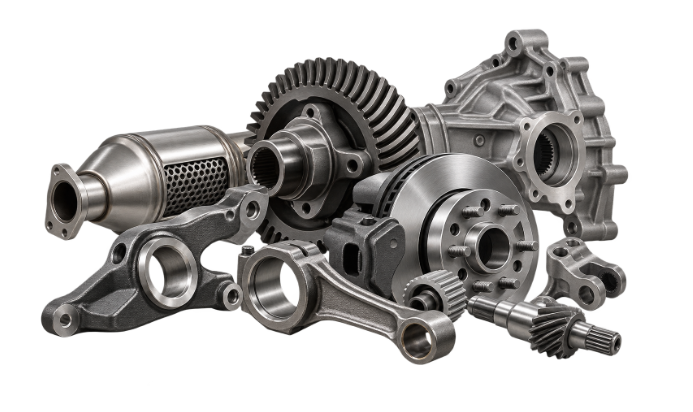
Typical Applications / Parts
DSB produces powder metal components deployed across core automotive systems, including:
- Stainless steel exhaust components
- Steering components
- Braking system components
- Body and chassis parts
- Drivetrain components
Manufacturing Technologies for Automotive Components
Automotive manufacturers need production processes that balance component performance, dimensional consistency, manufacturing efficiency, and cost at scale.
DSB Technologies combines advanced powder metal manufacturing, metallurgy, and engineering expertise to help automotive OEMs and suppliers select the right manufacturing approach for complex, high-performance metal components.
Produce complex automotive components with fewer secondary operations and scalable manufacturing.
Metal injection molding enables intricate geometries, integrated features, and near-net-shape production for automotive components that may be difficult or costly to machine. MIM can help reduce machining requirements, consolidate features, and support repeatable production at volume.
Support high-volume automotive production with efficient, repeatable powder metal manufacturing.
Powder metal compaction is well suited for automotive components with geometries compatible with conventional pressing. Near-net-shape forming can reduce material waste, limit secondary machining, and support consistent production of drivetrain, chassis, and other mechanical components.
Develop the material properties and dimensional consistency that automotive applications demand.
Sintering is critical to achieving the required density, strength, and metallurgical characteristics of powder metal automotive components. DSB's sintering expertise supports process development and control to help meet application-specific performance requirements and repeatable production.
Evaluate automotive component performance and manufacturability before scaling production.
Automotive applications often involve demanding requirements for strength, wear resistance, corrosion resistance, and dimensional stability. DSB works with engineering teams to evaluate material options, component designs, and manufacturing feasibility early in development, helping identify potential challenges before production investment.
Explore complex automotive geometries and new design possibilities beyond conventional manufacturing constraints.
Metal binder jetting offers design flexibility for automotive components with intricate features, internal passages, or geometries that are difficult to produce using traditional processes. Combined with DSB's metallurgy and sintering expertise, binder jetting provides a way to evaluate innovative component designs and their potential path toward production.
Meet automotive component requirements with targeted finishing and precision operations.
Some automotive components require additional machining, sizing, heat treatment, or surface finishing to achieve their final specifications. DSB helps evaluate secondary operations as part of the overall manufacturing approach, balancing dimensional accuracy, component performance, and production efficiency.
Materials Engineered for Automotive Component Performance
Automotive components must meet demanding requirements for strength, wear resistance, corrosion resistance, thermal exposure, and dimensional consistency.
DSB engineers and metallurgists work with automotive OEMs and suppliers to evaluate material selection based on component function, operating conditions, and production requirements. From established powder metal alloys to custom material development, we help identify materials that balance performance, manufacturability, and cost at production scale.
Materials used in DSB automotive components include:
Stainless Steels
Corrosion Resistance & Thermal Performance. Stainless steel alloys offer options for automotive components exposed to moisture, corrosive environments, and elevated temperatures. Material selection depends on the specific operating conditions and required mechanical properties.
Iron-Based Alloys
Strength, Wear Resistance & Durability. Iron-based powder metal alloys provide options for automotive components requiring mechanical strength, wear resistance, and repeatable production. Alloy composition and processing can be evaluated around application-specific performance requirements.
The Right Material Starts With the Application
Not every automotive component has the same performance requirements. Material selection depends on operating conditions, mechanical loads, component geometry, and production volume.
DSB combines metallurgical expertise with multiple powder metal manufacturing technologies to help automotive engineers evaluate the right material and manufacturing approach.